

Tuesday, November 16, 2010


Monday, October 4, 2010
Monday, May 17, 2010
Thursday, March 4, 2010
Thursday, February 25, 2010
Globalist - An Eye for an Eye - Op-Ed - NYTimes.com
My fathers murder is cited:
Globalist - An Eye for an Eye - Op-Ed - NYTimes.com
Globalist - An Eye for an Eye - Op-Ed - NYTimes.com
Monday, February 22, 2010
Kirtan in Los Angeles: Crossroads of traditions

Kirtan in Los Angeles: Crossroads of traditions
an article covering Joey Lugassy and MoMo Loudivi
Francisco Letelier
Wednesday, February 10, 2010
Miracle Quest: Abu and Gary
Gary Nelson is a cultural treasure;
a gifted songwriter and guitarist I have known him
since the lates 70's when I lived in Berkeley.
Here is a sample from his latest album.
Follow links there for more music and
check out the cool collage I made for them.
Myspace.com: Music - PopUpPlayer
a gifted songwriter and guitarist I have known him
since the lates 70's when I lived in Berkeley.
Here is a sample from his latest album.
Follow links there for more music and
check out the cool collage I made for them.
Myspace.com: Music - PopUpPlayer
Saturday, February 6, 2010
Dawson Island - Isla 10
In the memoir article I wrote for Tin House, I mention Dawson Island,
where my father and others were held in a camp after the coup in Chile in 1973.
Director Miguel Littin, has done an extraordinary job of bringing Isla 10, by
Sergio Bitar to the screen.
"I felt like the protagonist of one of those World War II movies.
When we arrived at the camp, some of us cried to see so
many wire fences. There were 27. It was difficult to believe."
Baldovino Gomez, Dawson Island prisoner
In the Magellan Straits in the extreme south of Chile, 100 kilometers south of Punta Arenas. Dawson Island was used as a concentration camp for the Selknam (Ona) and other native people in the 19th century. In 1890, the Chilean government gave some Salesian missionaries from Italy a 20-year concession to Dawson Island to educate, care for and adapt indigenous people.
From immediately after the military coup of September 11, 1973 until October 1974.
About 30 important political figures involved in Salvador Allende's overthrown Popular Unity (UP) government were sent to Dawson Island following the coup, alongside some 200 prisoners from the local area. Among the UP prisoners were Orlando Letelier, Jose Toha, Christian Democrat Senator Sergio Bitar, and former Mining Minister Benjamin Teplinsky.
* cited from Derechos Chile- an excellent site for a broad overview of human rights history in Chile.
http://www.chipsites.com/derecho/campo_isla_dawson_eng.html
where my father and others were held in a camp after the coup in Chile in 1973.
Director Miguel Littin, has done an extraordinary job of bringing Isla 10, by
Sergio Bitar to the screen.
"I felt like the protagonist of one of those World War II movies.
When we arrived at the camp, some of us cried to see so
many wire fences. There were 27. It was difficult to believe."
Baldovino Gomez, Dawson Island prisoner
In the Magellan Straits in the extreme south of Chile, 100 kilometers south of Punta Arenas. Dawson Island was used as a concentration camp for the Selknam (Ona) and other native people in the 19th century. In 1890, the Chilean government gave some Salesian missionaries from Italy a 20-year concession to Dawson Island to educate, care for and adapt indigenous people.
From immediately after the military coup of September 11, 1973 until October 1974.
About 30 important political figures involved in Salvador Allende's overthrown Popular Unity (UP) government were sent to Dawson Island following the coup, alongside some 200 prisoners from the local area. Among the UP prisoners were Orlando Letelier, Jose Toha, Christian Democrat Senator Sergio Bitar, and former Mining Minister Benjamin Teplinsky.
* cited from Derechos Chile- an excellent site for a broad overview of human rights history in Chile.
http://www.chipsites.com/derecho/campo_isla_dawson_eng.html
Friday, February 5, 2010
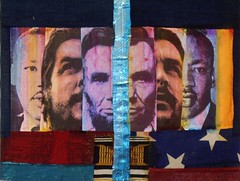

Behind The Wheel part 1 of 9
Behind The Wheel by Tao Ruspoli with Francisco Letelier, Oliver Stone, Robbie Conal and others.
Painted Son- Documentary
Trailer for "Painted Son" by Christopher Gallo a documentary about Francisco Letelier.
with Jackson Browne, Tom Hayden, Chilean Senator Juan Pablo Letelier, Rene Castro,
Monday, January 25, 2010
Canyonland/ La Quebrada

There was a doorway 70 yards up the narrow canyon of the street. At street level small shops were shuttered behind rolling gates and metal doors. Even then it was a one-way street, uptown traffic entering from wider avenues as it funneled into the labyrinth of the downtown quarter.
All the cities phantoms could be felt there. At the corner, kiosks displayed manufactured headlines, Disney comics, Uncle Scrooge and Donald eating Nestle chocolate. The lines of desperate housekeepers had disappeared, bread, butter and cooking oil suddenly appearing from stores hoarded underground. The broom-seller would still appear in the early hours hawking his wares as always, shrouded in rags, early morning fog and hoarse intonations, but over time, his lamenting call would fade in the low growl of incoming traffic.
In the past, wagons drawn by horses piled with produce for the market along the river would squeal wooden wheels and ring hooves against the stone of the street. Sometimes still in the desperate hours of night we could hear hooves echo but discern no wagon, no driver.
There was no traffic now, only eddies of stray newspaper sheets and trash relentlessly pulled and snagged towards the upper stories of the buildings glittering gray and raw in the weak streetlights. Already there was the smell of bread. Rising, I reasoned, from a subterranean place somewhere below through gratings set near the curbs. Curbs chiseled by hands and hammer as always by unknown workers from the cold grey Andean stone that surrounded the city. If you knew where to look, you could always find a sharp shard or sliver of stone, to use as a dagger or tool.
Outside, watchful for undercurrents of resistance, the dragon waited, its
glittering scales guarding treasures against delusional threats. Trucks loaded with soldiers would randomly roll down the street. The soldiers, disfigured by haircuts and blunt razors, were nearly children still, young boys from the provinces fed lies and fear by priests and generals.
I had spied on them, watched them suddenly stop and perform their drills. They would move with their backs against the buildings, spidering around entryways, swiftly pointing carbines into dark places, scanning the windows of the apartments above them for rebels resistance and phantoms. I had seen the bodies and pools of blood left behind by these groups of young men. Once because I could not help myself, because it was a precious treasure, an act of resistance, I watched late day maneuvers from behind the mattresses we had put up against the balcony railings. One soldier saw me from his dark perch atop the dome of the Palace of Fine Arts and sent a bullet whistling past me. I tasted gunpowder and fell down to the ground, thinking I had been hit, a ringing in my ears. The ringing went on for days, I never told a soul. I became more fearful but also more careful, and never stopped watching the shadow play.
I knew that boys like these Orcs*, night doppelgangers stolen and twisted from the heart of the frozen nation were the root and stock of the future, authentic and legitimate inheritors, subjects of the dream the dead had dared to dream.
Boys, spell cast and charmed along the Humboldt Current towards the Antarctic Circle, held my father and others in cages and behind bars, in camps and secret prisons.
I could smell the fear emanating from them. Early on I had learned to recognize the effects of hunger and rags, the trembling fear of stray dogs, the ferocious innocence of survival. Knowing the tragic nature of their homespun terror my revulsion and fear were paired with a measure of compassion.
In order to bypass the checkpoints of soldiers on the main road that led to my school I would take a trek through the fields that surrounded the grounds, jumping irrigation ditches and fences. Once I heard a rustling, and in the corn I saw a friend. His father had worked at the school and disappeared in the first days of darkness.
His head was bleeding with deep gashes, the soldiers had caught him, the same boys who had taken his father away. They had given him a haircut with their bayonets. He was washing off in the irrigation ditch. He had no shoes, his toes were muddy, tough and seemed prehensile, the soles of his feet calloused. I remember admiring him for that, he was Tom Sawyer in a demented Oz. He explained a safe route in, told me to be safe and careful. I never saw him again.
In a room lit by strawberry scented candles, listening to outlawed music. From the window I could see the doorway, a caged light in blue grey dimness briefly outlining its contours. I had stayed too long. Cigarettes and poetry, Castaneda, wine and an American girl, both of us so much older then, during the winter of the Dragon in Santiago, then we would be later. I had forgotten the time and stayed past the curfew. It was especially dangerous during the first hour.
The goblin horde preyed on late workers struggling to make it home far away in a ghost town devoid of transport. The flesh of a cousin or brother seemed delectable, teeth gnashing. The poorer the prey, the younger, the more feminine, the older, the sicker, the more enticing, the better to expedite guilt.
It was 70 yards to the doorway at 12:30 in the morning, my friend crying now, certain we would be caught, her mother at the American Embassy not knowing she had entertained the wrong boy that night. I would take the service stairs down the back side, the door downstairs would open onto the street and lock behind me, I would have to run and open the service door to the building I lived in and disappear before a patrol or truck or sniper spotted me, a shadow on the forbidden streets of a city I had once known.
During working hours, if we left the building, we were constantly watched and monitored by men in ill -fitting suits and sunglasses. Often, late at night, the stairs would host the marching of boots as squads of soldiers would arrive led by a colonel who somehow would try to seduce my mother with raids, searches and bottles of fine wine. I would go to my room, the soldiers would walk through pointing guns, silent, waiting for any reason at all, smelling of fear. I would hear my mother's delightful laughter, charming the Nazgul* in the living room, gaining another reprieve, weaving an enchantment for protection.
There were informers everywhere. Building managers had disappeared and been replaced by patriotic former soldiers. There were shopkeepers longing for favors, as well as idiots and neo fascists tugged by the need for recognition by the shock troops of the new nation of interconnectivity. Outside the dragon waited and I was already a thief. Found after curfew on the streets I would taste more than gunpowder, end up with more than a bayonet haircut. I would be phantomed, become one of the early dawn spirits that I could sense in the morning fog of the street. I would disappear.
Growing in the mountains and hills surrounding the city there were trees and shrubs known to have medicinal properties. Travelers from the south often came to the city
with herbs and leaves, but many grew nearby. These were used for a vast number of known ailments and human conditions. The Canelo tree, sacred to the Mapuche natives could be used for rheumatism and circulatory problems, its disinfectant qualities helped in healing lesions of the skin. Little leaves of Cedron or Boldo, infusions of Quillay or Maqui. For sadness, for ulcer, for love, for fortune.
Up in the quebradas of the mountains, in canyons where trees still whispered, I could almost let myself remember how hard things were. The mountains knew how to care for me, through cold and fire, through silence and impatience. I would climb and seek the shrubs and trees, fill plastic bags with leaves and bark. Sometimes, alone I was able to risk enough, scrambling through dangerous and steep terrain. There was always someone up in the hills, an old woman, a boy, a man. Knowing the road and the hills, seeing my bundles, telling where to go, when a bus might come by, where to buy bread, how to jump fences, escape dogs.
I asked my friend to lend me her blue sweater. It was the kind used by most students.I wanted to look like a student. Suddenly down the road near the kiosk lights appeared, we ducked back from her window. There was shouting and the sound of a scuffle, the sound of a truck grinding to a stop. The smell of diesel wafted up to us, we heard a soldier asking questions and a low keening, almost a wail, in reply. Spotlights shined down the street and glinted off the windowpane. I could smell bread baking. There were scuffling sounds and then a brief moment of complete dark, before the truck started again and careened up the street against the usual traffic flow. We looked out a few seconds later to see an open truck full of little goblins take a jackknifing turn onto the circular avenue along the river and its tall trees.
Now. I ran down the stairs towards the back street entrance and looked through the thick scratched glass and could see nothing. My friend stood at the top of the stairs. I told her I'd signal her from my window soon and not to worry. I stepped out and was closing the door quietly when out of the next doorway someone familiar appeared. He was cursing and didn’t seem to notice me. As I crept passed him, he whispered, 'Hey, chicillo, (kid) what are you doing? Get home, be careful, those mother fuckers are crazy and you're not in the hills now.
I knew him because he sold herbs on the sidewalks downtown, constantly both harassed and sought after, by police and cognoscenti. He has made crude maps for me on scraps of newspaper and old lotto tickets, places where good things grew. Many years later, I saw a Lonely Planet postcard with him surrounded by wares somewhere in Mordor*.
His handwritten signs in pencil on cardboard next to bundles stems and open bags of aromatic leaves. I don't remember seeing him again either, although I looked for him many years later when I returned.
The key, usually stubborn and useless, glided smoothly and the door swung in, opening easily. I made my way up six flights silently in the dark. Slipping in I went to my room and lit my bedside lamp, I held it against the window facing the street, the crack in the old casements whistling softly with the winds coming from the snow peaked mountains that surround the city. I turned it off and on several times, random signals.
She did the same, 70 yards up the street. Her signals would bounce off a big sign halfway between us on the other side of the street. It was hung from a third story balcony and sometimes got clipped by tall trucks. When they reached me I could see them in a mirror I had facing the street at a calculated angle.
On the short wave radio, I heard news from across the world. Vietnam was unraveling, Deep Purple was playing somewhere in the distance. No news about the Zombies and killings, no international peace-keepers on the way in big transport planes and helicopters. I would not make it to the mountains again before we would escape. Outside it had started raining. Nothing stopped the rain, or forced it to cooperate. It helped the plants grow, it helped the trees, it crowned the mountains. The blue was never more heart crunching than when the final clouds blew away and the mountains appeared wreathed in sky and snow. I knew that there in those places something was waiting. Something not determined by the senseless tragedy that was Santiago that winter, but as real as bread and as powerful as bombs. Part of it was embedded in the music poetry and colors that were now illegal, bits of it in our neglected folklore, in wine, in the plants and trees, in the earth itself. It extended way beyond 70 yards of street with its phantoms and whistling bullets, woven into what we had dreamt we could become, before the dragon awoke.
Francisco Letelier 2009
* Nazgul, Orcs and Mordor are creatures and places of darkness from 'The Lord of the Ring, JRR Tolkien's classic trilogy. Along with Carlos Castaneda's first books about his relationship with Don Juan, a Yaqui Indian Shaman, Tolkien's world became a place of refuge for me during the months after the military coup in Chile (1973).
Note:
Quebrada is the term often used for 'canyon ' in Spanish, literally meaning a break or broken place. The designation is elusive however since it can refer variously to a small stream or brook which can not be navigated, or a dry steep wash or arroyo. Sometimes a quebrada is a narrow canyon or differently a narrow passage, as in a pass through the mountains and so does not refer directly to the ravine itself or to the waters which may have been its catalyst but to the fact that it provides a way through the mountains or cliffs. Additionally it may also be used to describe a wide high mountain valley or gorge.
Chaparral Wail

Chaparral Wail
Francisco Letelier
I don't remember when I started singing, and truth be told, I don't know where or why. Some of my songs, I've known as far back in time as I can remember. I don’t know where they came from, what caused their formation, why those sounds arose. There are others though, that I remember precisely, from first stirrings to their final sounds. I know why I began them and how I ended them, remember when I have sung them and why and where I have chosen not to.
It was first the sound of skateboard wheels over sidewalk lifted by Coral tree roots. For years the tree on a corner between street and alley had served as cover for crack sellers and jittery buyers. Few would pay attention to the hard, shiny and fiery red seeds of the tree or the intricate brachiating which had brought them into being, Instead they were thrown away in contempt by the Jonesing smokers who shuffled along searching for bits of errant rock.
Elsewhere in the warren of streets things were changing, the boundaries of overt activity dwindling slowly, but in Dogtown's ombligo, in the creases of the dark bellybutton, some things had yet to transform or diminish. A pretty lady walked down from the bus stop on Lincoln looking to have a good time. All dressed up, she knew this place, her heels made a nice rhythm. On Abbott Kinney a woman with a Humvie stroller, made her way past dogs and tables, past the traffic light and up into the Hood. The grocer’s truck rolled slowly down the street, its tin music blaring from blown speakers, a reassuring modality. Hanging on the back, a young man, learning the ropes, just arrived from Michoacan.
The same colors, the same fruit and vegetables he has always known, but here from the open back of the truck, its as if he's never seen a papaya, a mango, a Mexican soda. As if his eyes had never been open until he rolled through the Hood. His uncle pulls into an alley as fruit rolls in boxes, they pass a young black man, dressed in white, making gestures at someone across the street. The truck stops a few yards down, his uncle gets out of the drivers seat and goes around to the other side of the truck, leafy branches hang over a tall fence. His uncle picks leaves off the tree, not too many, a little goes a long way. He knows the tree allready, in fact everyone from his town who had made it to this place knows it well. An infusion made from its leaves helps the heart, helps to dream of loved ones, keeps you strong. His uncle jumps back into the truck, makes the music blare once again and slowly, the rolling market moves down the alley.
I felt the rumbling wheels, and felt the tug of the tree, like a warning or premonition. The muffled crack of gunfire, the tires speeding. I had already started a song for the boy, just returned from Juvie, bigger now more filled out, sporting new clothes, acting invulnerable. He had been so loud, and gotten louder as his tryst with pipe and rock grew and took him over. Another boy. One after another, there had been so many that summer.
Layers of boys and cars and spent lighters lining the alley, tags and imposters of every stripe, the shiny cars of people from other places, taxis and bicycles in the dark, laser lights flashing, dark figures rushing at cars at folk just coming home to the narrow territory where ghetto birds chopped night air and criminals drove fancy new police cars.
He was a good boy, and he was family; grandson, nephew, uncle, son. It was all right to do some time on the street, after getting out of his second term in the halls and camps. He brought money home and he was generous. The surviving men over 30 encouraged him, he did as he was told, he understood us and them, he dreamt the dreams of dwindling imagination.
I sang his song through the roots of the block, light speed volatile scents, into the treetops, the remaining big palm tree on the empty lot near Vernon. The Red-tailed Hawk in its fronds harassed by crows, could smell his blood seeping dark underneath him on the broken pavement in the liminal space between 6th Avenue and alleyway. His clothes were white that morning, clean, not a spot on the white shoes he had bought from the Korean lady at the swap meet at the old Fox theater on Lincoln. He was a good boy.
As he died, the coral tree pushed against it skin, its thorns glistened, repeating my phrasing, a song that pushed all the way down to the shore along the breakwater.
The lady with the monster- stroller was reaching for her Blackberry, a text message alerting her that she had to hurry as she crossed the street at Brooks Ave. Up ahead a mound of white, something in the street. She had made good time that morning, hitting the farmers market early; the baby still sleeping, the older one awake, enjoying the ride. As she arrives at the curb, a woman walks down the sidewalk in front of her. She hesitates a bit to get some room between her and the woman. She has seen her before, sometimes standing sadly at stoplights on Lincoln, sometimes getting into taxis and cars, often under the tree up ahead, watching the street. Today the woman stumbles a bit and then walks hurriedly on towards Rose Ave.
At the tree and its patch of broken sidewalk she slows and realizes there is a dead boy in the alley. She keeps walking with the stroller, hardly missing stride. She thinks about protecting her children. A car is slowing down. By the time she crosses Indiana she is dialing 911, she never looks back, wants to move to somewhere better, its so hard to raise children in Los Angeles.
She can't hear me singing, she quickens her pace, checks her Blackberry, cloak of invisibility.
*
I don't remember who first heard me, encouraged me, compelled me, taught me and so marked me, that I continued to sing, until everything became entwined with my songs.
I no longer know where my songs end and I begin, but I do remember that once in the deep dark shadows of the hills I was silent. I recognize that silence, in the dead boy, in the woman who makes the rhythm with her feet, who sells her body for little bits of rock, in the woman with the stroller and the children her left ankle tattooed and crisscrossed with fashionable symbols from far away.
Even in the places where things have remained untouched by human hands there has always been something or someone to sing for. Back into time there are those that have heard me and allowed my songs to find a home.
That is why I sing.
Now, the air itself is full of songs, and the earth and stones hum constantly from frequencies and vibrations. Digital frequencies pierce through me through the mountains across the ocean into the sky, but they are the wind that does not know itself, like gusts that rise from rocks and streams, from streets and tall buildings racing down canyons and corridors searching desperately for something that might tell them what they are.
They come and go.
Between the gaps of history I am standing in starlight just beginning now to sing. There is no end to my songs, even now when the old ones are leaving us, even now when the water is poisoned, even now when the sky may fall.
Near the corner of Lincoln Boulevard and Washington in Venice California, there was a spring of clear water, fragrant and bubbling from deep bedrock. Near that spring, when this place had another name, my roots joined with an Oak tree that had stood and grown and sung for 200 years. That Oak is no longer there, its roots invisible and gone, swallowed by hardened concrete and the layers that fall away there into the deep. Still glowing in the places it inhabited, it continues its song.
Digital Blockbuster Billboard glows as tires roll. Millions of bumper stickers conversing knee high chrome glint grunts. Inside boxes, in your branching tendril root networks of frequencies I am an eternal polyglot. I understand your language, sometimes someone recognizes my songs, the sense language bio barrier glitching long enough for the recognition of a sequence, a subtle atmospheric change, the hollow overtone of our synchronization. But the listening is like a forgetting, as if small part of me is finally sensed, only to be put away on play lists and archives. Digitized, sampled and truncated I am compressed on Face-book pages, snatches of me on You-Tube and Wiki data. Sometimes when the cars pull into the 7-11 at the mini mall on that corner, near Alejo's, close to the Chinese doughnut shop, I feel the limbs of the Oak as I send my songs to whisper between the opening of clear glass, metal framed doors, as the flickering of fluorescents whispers the false scent of chlorophyll. I-pod therefore I -am.
*
Kiosk magazine rack near Palms and Abbott Kinney Blvd.
Research by scientists has shown that plants are “capable of more sophisticated behavior than we imagined,” “Plants are capable of responding to complex cues that involve multiple stimuli,” Some say “Plants not only respond to reliable cues in their environments but also produce cues that communicate with other plants and with other organisms, such as pollinators, seed disperses, herbivores and enemies of those herbivores.”
*
Close there along the narrow sidewalk, cars slinking I sing. I've been mistaken for many things; another channel, another metal box with a particular gleam, a gleaming body, a careful construction, the roar of the ocean sneaking in under or above the muffled roar of internal combustions, rolling rubber, burning brea. Once, a man swore I was a radio, a recording amplified through complex mechanical sound systems, mistaking, misunderstanding, as if my song is made to be heard through human ears.
It is in the other senses I do better. In the flat place where only four directions exist, where it is taught there are only have five senses, it is impossible to catch multidirectional song made from branchings, circles, ups and downs. The geometry is practical and multiplied, an impossible mandala, a fractal, a stain in the asphalt. Depending from where you listen from, from where you look upon, touch, taste, or sing from, you might not hear me. There is no song without other senses, without a sense of direction, without a sense of belonging. Your sense of danger could help you hear my song, but how to differentiate mine from all the frequencies of danger that are born bought and sold along that and so many other boulevards?
As the road moves, a sense of migration or cunning joined to the glow of the sky towards the west, might bring you towards my sound. Towards the North in Santa Monica Canyon, and along Ballona Creek to the South it is easier for me, but here at this corner, I rise up next to the bus stop or sing to a homeless person sleeping on the street and it seems most do not hear me.
My Dogtown T shirts read: Stop texting, I was your friend before Facebook, I stalk you for your own good, You are my reason to Twitter.
They are tattered, dirty scraps of rags, the Rose Avenue Hermit now at a new corner near Venice Blvd, a building under construction. I tore them up hung them on metaphorical wires over intersections, sent tendrils of graffiti shoots tentatively suggesting their form on walls and traffic boxes. Om me now, huh?
I am the roots listening under earth, the birds and raccoons conniving still, coyotes rushing, singing at you, the home grown call waiting for response. We are made for one another, I am dismally free and available to all.
Known systems impede our dance. I am singing for you, my biophilia has no lineage or form. It is better to speak in known language better to sing from the heart, better to sense than to prove. I have always loved songs from other places, always understanding there is a science that links the earth, plants and geography. If you are here, (are you here?) don’t forget to drink of these waters. Enamored, dazzled by the magnificence of what once was sung in a place far away, people might fail to hear the thing that is waiting to be born right next to them.
*
Images projected from millions of screens, I wake like a morning news junkie, people logging on. In a vast network, capillaries and tendrils exchange notes and waters.
The simulation had become so strong it resembles me. Lifelessly, it lays out a web that patterns and mimics me in holograms and plottings. It is hard to distinguish between the image and the thing itself, but here I am.
"Volatile signals, defending against disappearance, transgenic, talking to herbivore, omnivore, responding to cues of self and non-self without physical contact.
I am the mountain singing chaparral, here to help you integrate your own systemic physiological processes. "
Lament
Jai- Jah- Ma- Om Me singing, me dirt below your feet.
breathing in, cloud now where you stand, no Buddha yoga, prayer business,
no network or hybrid needed for sustainable growth,
no psychic plant brew, no trip to Bali,
no massage, vegan raw faced latte
No Shiva Saul kirtan, no walk street conversion
no pilates, no bindi, no tithe, no creed
intensive, just a feeling, just the giving,
just a walk man, just a walk then, just the earth woman, just the plants.
Wrentit playing in the Coyote Brush,
in the Monkeyflower, in the Deerweed.
Where you are, where you live.
What of the trees? What of the seeds?
What will you touch with your hands?
No sanitizer, airborne laser ultraviolet recharge man,
water that is too pure has no fish.
Funk, dirt, legs walking.
Just the cry of birds, just the Towhee,
just the Thrasher in the bush.
No Hanuman live here, only California Grey squirrels,
no Jesus, no secret, no clever thinking.
Just the Wrentit playing in the Coyote Brush,
in the Monkeyflower, in the Deerweed.
*
Sometimes people never touch the ground, feel the wind, receive the light of stars or moon. They do not touch other people physically and talk, letting everyone know as quickly as possible that "they should go outside and put their hands deep into the ground, breathe now, it waits for you, let the song enter so that we may continue to grow."
Far away in heaven where the Internet begins, someone logs on, lamenting for the earth, Global warming, Haiti, Iraq, Iran, Oil, Obama, Afganistan. Unemployed, trying to be like Job or Siddhartha. Ancient mystical prayers and images, clever Bio- neer entrepreneurs.,,
Don’t let the workshops interfere with the natural tendency to take your shoes off and feel the sand between your toes. That is, training the limbic system to release synaptic fluids, that is, aligning the core, that is, moving the prana, awakening the kundalini, chanting or sweating or preparing the raw names of the sacred.
Let your meditation, let your goddess, let your green promise, your at-risk 2012 prediction begin by finding a place to feel the world of life living around you, and just for a breath or two let sweet chaparral sing for you, let the birds fly for you, let the Nature Deficit Disorder wash away from you.
Back into time there are those that have heard me
allowing my songs to find a home.
That is why I sing.
*
Apendix
Nature Deficit Disorder : describes our lack of a relationship to nature and the environment. It hurts children, families, communities, and the environment itself.
A concept still kept within discussions about childhood education and damage of media to children, most adults suffer from this condition globally. Not a condition limited to urban areas and cities, cures and remedies are in your own backyard.
Biophilia- The term "biophilia" literally means "love of life or living systems." It was first used by Erich Fromm to describe a psychological orientation of being attracted to all that is alive and vital. Edward O. Wilson uses the term in the same sense when he suggests that biophilia describes "the connections that human beings subconsciously seek with the rest of life.” The biophilia hypothesis suggests that there is an instinctive bond between human beings and other living systems.
Gaia philosophy (named after Gaia, Greek goddess of the Earth) is a broadly inclusive term for related concepts that living organisms on a planet will affect the nature of their environment in order to make the environment more suitable for life. This set of theories holds that all organisms on an extraterrestrial life-giving planet regulate the biosphere to the benefit of the whole. Gaia concept draws a connection between the survivability of a species (hence its evolutionary course) and its usefulness to the survival of other species.
While there were a number of precursors to Gaia theory, the first scientific form of this idea was proposed as the Gaia hypothesis by James Lovelock, a UK chemist, in 1970. The Gaia hypothesis deals with the concept of homeostasis, and claims the resident life forms of a host planet coupled with their environment have acted and act as a single, self-regulating system. This system includes the near-surface rocks, the soil, and the atmosphere. While controversial at first, various forms of this idea have become accepted to some degree by many within the scientific community (See Amsterdam declaration on Global Change). These theories are also significant in green politics.
Chaparral is California’s most extensive, native plant community. It is also the state’s most characteristic wilderness, dominating foothills and mountain slopes. Take a drive into the hills surrounding nearly every southern California metropolitan area and you are immediately immersed in chaparral.
Properly defined, chaparral is a semi-arid, shrub dominated association of sclerophyllous, woody plants shaped by summer drought, mild, wet winters, and infrequent fires. Meaning “hard-leaved” in Greek, sclerophyllous leaves are advantageous in a semi-arid climate because they reduce evaporation thorough a variety of traits including waxy coatings, thicker cell layers, and recessed stomata, the pores in leaves permitting evaporation and the exchange of oxygen and carbon dioxide.
* Black sage (Salvia mellifera)
* Bush monkeyflower (Mimulus aurantiacus)
* Bush rue (Cneoridium dumosum)
* Ceanothus (Ceanothus spp.)
* Chamise (Adenostoma fasciculatum)
* Chaparral Pea (Pickeringia montana)
* California buckwheat (Eriogonum fasciculatum)
* California Coffeeberry (Rhamnus californica)
* Deerweed (Lotus scoparius)
* Islay or Hollyleaf Cherry (Prunus ilicifolia)
* Laurel sumac (Malosma laurina)
* Lemonade berry (Rhus integrifolia)
* Manzanita (Arctostaphylos spp.)
* Mission manzanita (Xylococcus bicolor)
* Mountain mahogany (Cercocarpus spp.)
* Redshanks (Adenostoma sparsifolium)
* Scrub oak (Quercus berberidifolia, Q. dumosa, Q. wislizenii var. frutescens)
* Silk-tassel bush (Garrya spp.)
* Sugar bush (Rhus ovata)
* Toyon (Heteromeles arbutifolia)
* Wild cucumber (Marah macrocarpus)
* Yucca (Hesperoyucca whipplei)
The Five Essentials birds of Southern California Chaparral
1. Wrentit (observed mostly by call)
2. Western Scrub-Jay
3. California Towhee
4. Spotted Towhee
5. California Thrasher
Birds especially common in chaparral for several years after a fire
1. Costa's Hummingbird (especially spring and summer)
2. Sage Sparrow (mostly winter)
3. Rufous-crowned Sparrow
4. Lazuli Bunting (April through September)
5. Lawrence's Goldfinch
Other chaparral birds
1. Bushtit
2. Canyon Wren
3. Bewick's Wren
4. Greater Roadrunner
5. Anna's Hummingbird
6. Black-chinned sparrow (April through summer months)
7. Fox sparrow (winter)
8. Hermit thrush (winter)
9. Golden-crowned sparrow (winter)
Subscribe to:
Posts (Atom)
